
The great need for paediatric care in Africa:
With the highest percentage of under-18s on the planet, the average age in Africa is 18, compared with 42 on the European continent.
% of the population under 14
(Source: World Bank 2019)
Spain
Senegal
Mozambique
Many NGOs focus their action on cataract surgery or the treatment of trachoma, as these have been a focus of interest for the WHO for more than two decades and affect many people.
However, less is said about visual impairment in children, even though it has a major impact on their quality of life (school performance, future prospects, safety…). Moreover, visual pathologies that are not corrected in childhood often become permanent, since the visual system develops during the first 8-9 years of life. The most severe impairments lead to greater difficulties in adulthood, with a major socio-economic impact.
The specificities of paediatric ophthalmology:
Paediatric specialisation is not adult medicine applied to children: it is medicine applied to a stage of life marked by growth and development.
Ophthalmologists stress the importance of detecting and treating refractive errors in children as early as possible, as this allows the visual system to develop correctly and prevents permanent, untreatable defects.
Refractive disorders and strabismus, sometimes associated, are the childhood eye diseases that most often cause visual impairment. They are usually treated with a simple pair of glasses, but access to glasses can be complicated and often impossible.
The lack of correctly prescribed glasses is the leading cause of visual impairment in the world.
According to WHO estimates, between 3 and 4 million children in Africa have a severe visual impairment, two thirds of them due to a lack of glasses.
An additional problem is that prescribing glasses for a child requires specific tools and technical knowledge that most eye care staff in Africa do not have:
- Measuring visual acuity (VA) in children makes it possible to detect most visual defects, but it requires knowledge of specific testing tools. For example, many clinics lack children’s optotype charts, with symbols instead of the letters used for adults, which are essential for diagnosing young children who cannot read yet.
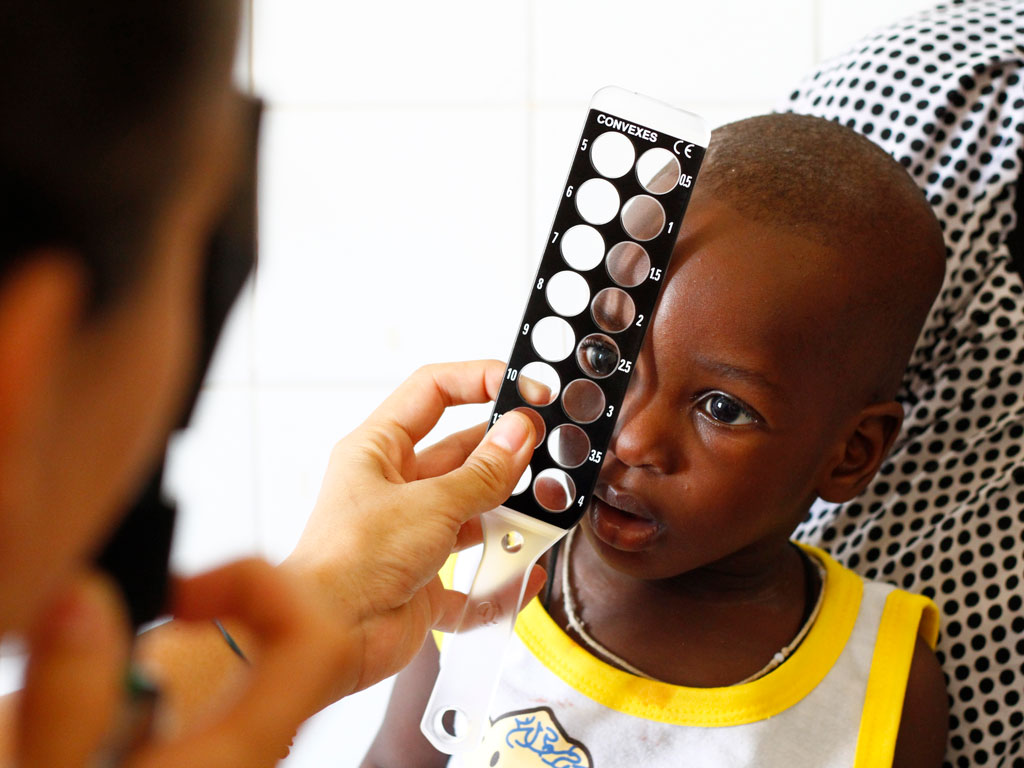
- Calculating the glasses prescription requires mastering retinoscopy, a technique for examining the reflexes from the back of the eye and detecting, for example, strabismus. Many clinics have neither a retinoscope nor a lens bar, which makes it easier to use.
- Recognising and treating amblyopia, also known as lazy eye: reduced vision in one or both eyes due to a lack of proper use during the visual learning period (the first 8-9 years).
- Knowing how to identify and treat strabismus, the leading cause of eye surgery in children.
For these reasons, OCULARIS focuses its action on training eye health professionals and teachers, with content focused on children’s care. We believe this is the best way to help these countries in the long term, improving their population’s access to health and, in turn, education, well-being and socio-economic development.